report on 3000 hours of vietnamese practice
2026-10-14
11 minute read
tl;dr: I now have conversations in Vietnamese with the woman to whom I am husband.
All tracked time is active, 100%* focused on the task at hand.
Passive listening time I estimate at 1150 additional inattentive hours.
Starting from: English monolingual beta
Current strategy: Read fiction, listen to audiobooks, chat online, translate fiction
Long-term goal: D1 fluency and a paid original fiction publication by 2040
Past updates:
Current level:
I am comfortable the comprehension side. While I have many weaknesses and there are things I can't make out here and there, I'm at ease watching show without subs, listening to audio books (nonfiction and contemporary fiction), and in group conversations with my wife and her friends. With advance preparation I can be confident in most situations.
What do I mean by advance preparation? Here are some examples.
Example 1: I went to a doctor in Vietnam because I fell several feet and tore a ligament in my leg. If someone surprised me with a conversation about the internals of a leg, I would not have been able to follow the vocabulary. But I was able to speak with the doctor effectively about "is it a tendon or cartilage thing" and which tendon did he mean, etc, because on the drive there, I read some wiki pages on leg anatomy in Vietnamese. As of writing this I no longer remember the words we used.
Example 2: I translated a fiction story of mine from English to Vietnamese which featured a ping pong scene. I had no idea how to talk about ping pong in Vietnamese, so I read the Vietnamese Wikipedia page on ping pong, and watched some youtube videos about it. Afterward I was able to translate the section without dictionary lookups. Before the preparation I wouldn't have been able to do this. I have forgotten most of the words I wrote by now.
Things I still can't do:
- Put on random novel audiobook and understand well. Contemporary romance and stories I already know are accessible, but in general novel audiobooks are still out of reach for extensive listening because of the information density. I can't process a sentence like "But behind the couch there were streak marks indicating something superhuman had been involved in the kidnapping that happened at 2pm the Tuesday three weeks before the shooting of the governor" in time.
- Reliably understand the first lew lines of dialog after a topic change in a show (e.g. it cuts from romance to a military or law-focused scene). I depend on context to follow along and the switches throw me off sometimes.
- Follow people when they describe their dreams. In dreams anything can happen and I find it pretty difficult to catch up if there's one detail I didn't understand.
- Come across as articulate or educated when I speak. My speech is clumsy. Unscripted speech.
- Catch contextual one-off idioms Vietnamese people say. These idioms don't show up much in novels or on youtube, my main study sources, nor are they in most dictionaries, so I collect them slowly by asking about each one as I encounter them.
- Reliably understand all Vietnamese speakers. While I understand the speech of people in Hanoi and Saigon well, there are some speakers, like the father in this yo bae video, that make me feel A2 again.
- Reliably understand Vietnamese speakers over low-quality microphones. Every so often I encounter a Discord room full of people who apparently understand each over a 20 kilobit connection, but it's as good as noise to me.
What I'm best at:
When media keeps a set context for a long time, I can follow along very well. Audiobooks about economics and history, like Sapiens (Lược Sử Loài Người) and 5000 Years of Debt (Nợ - Sợi Xích Vô Hình 5000 Năm) are comfortable for me, and I don't feel like I'm understanding much less than if I listened to them in English.
This is true for fiction too when the context is very static. When reading all twelve volumes of Death Note, there were only twenty words I didn't know and most of those I immediately figured out. Harry Potter readings on youtube are also easy to follow.
As a counterexample, in Dune (Xứ Cát) there were 521 words I didn't know, and I could not figure most of them out from context. It covers history, politics, ecology, etc. The wide possibility space made inferring meanings harder. I had to use the dictionary pretty much every time.
A big new thing:
I have crossed a threshold now where I can comfortably talk with the woman to whom I am husband in Vietnamese. In the cab ride home from seeing The Odyssey, we discussed the plot, what we liked and didn't like about the movie, and I was surprised to find that I had the words to refer to the relevant ancient civilizations and whatever else was necessary.
In the beginning I didn't want to ask my wife for help studying because that's, like, a job, and so I just pushed the whole idea of us speaking Vietnamese out of mind until I was "ready". And I actually pushed it so far out of mind that a few days before we went to see the movie, I was privately quite down about how much time I had put into the language yet did not have relationships with native speakers in which to actually use the language. Remembering that I was married to a native speaker was an incredible surprise.
What I still won't attempt:
Vietnamese literature. Though I've made a couple exceptions, Vietnamese literature needs to stay far away to maintain its macguffin function. It's what I'm working toward, and I want to be able to read and listen to fiction very comfortably, at the level of an eager literature undergrad, before I experience, for example, the original works of Nguyễn Ngọc Tư.
If I go into it too early, and have to look up hundreds of words like I did while reading Dune, well that just doesn't seem very fun.
Rejected Strategies:
- Apps (too boring)
- Grammar explanations (too boring)
- Drills, exercises, or other artificial output (too boring)
- Content made for language learners (too boring)
- Classes (too lazy for them, and not sold on the value prop)
Methods:
My routine is as follows.
Before work:
- (1h) Pace around my house (in the winter) or take a walk (in the warm seasons) listening to an audiobook.
At lunch:
- (30m) Listen to a novel or harder book, with dictionary, reading along with a text copy.
Before bed:
- (30m) Read manga sans dictionary.
On Tuesday evenings:
- (1h) Translate fiction from English to Vietnamese with a tutor.
Whenever:
- Hop on discord and chat with native speakers about topics of interest.
I may do more if I’m into a show or book in Vietnamese, which naturally happens more often. Recently I enjoyed the audiobook Điểm đến của cuộc đời by Đặng Hoàng Giang, a Vietnamese work about death.
Time Breakdown:
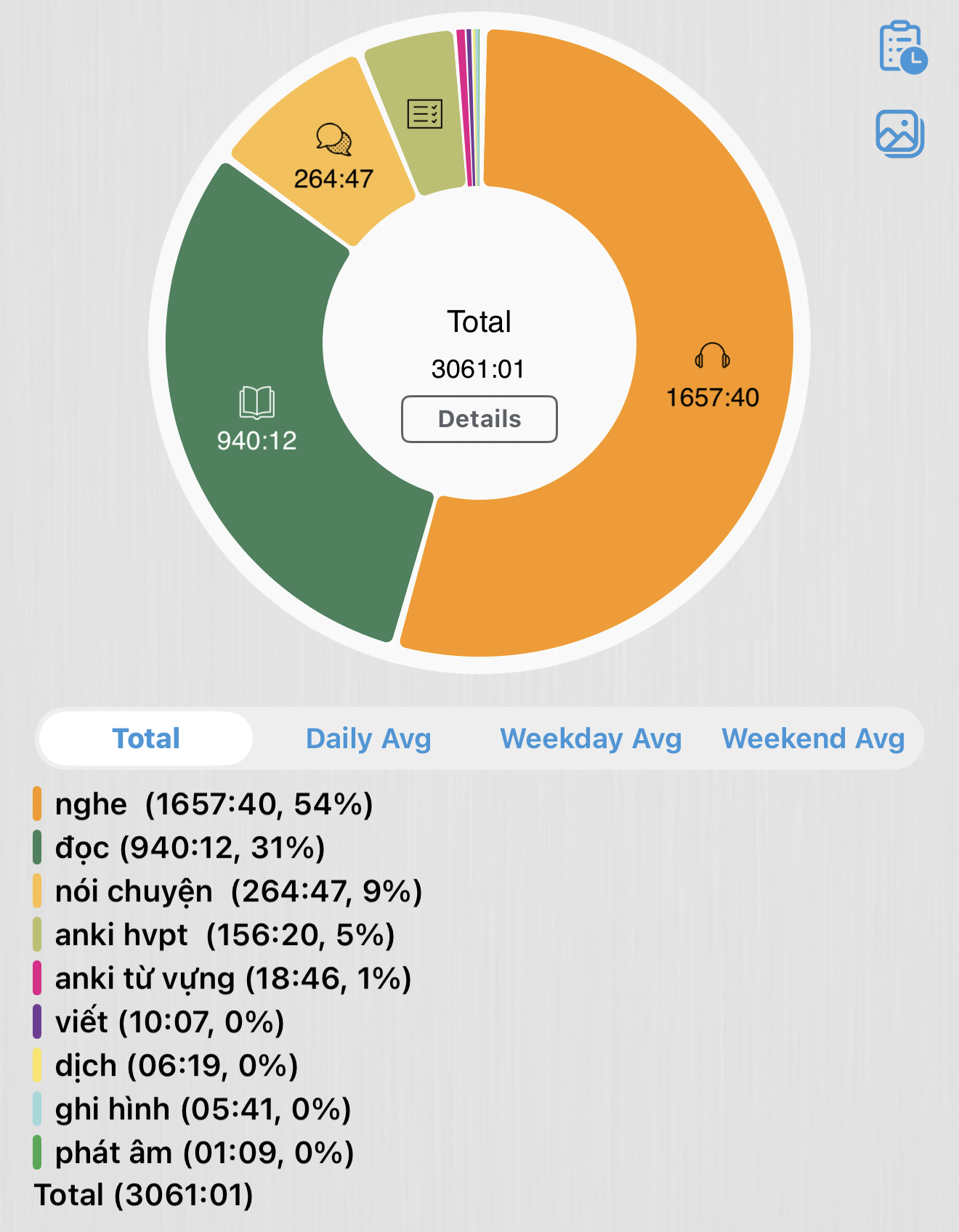
I use atracker on iOS since it's got a quick interface on apple watch.
- 54% listening (1657h40m)
- 31% reading (940h12m)
- 9% conversation (264h47m)
- 5% anki audio sentence recognition cards (156h20m)
- 1% anki vocab (text + audio front) sentence cards (18h46m)
- 0% writing (10h7m)
- 0% speaking to camera (5h41m)
- 0% chorusing practice (1h9m)
Reflections:
In the beginning of learning Vietnamese, I was under the impression that native speakers represented the height of the language, and that the degree of distance between a learner's speech and native speech was the degree to which that learner was not good at the language.
Since starting, I've read some writing on the topic (most persuasive being Yoko Tawada's Exophony) that have changed my mind.
I once worked with a Turkish man who, if you told him something he already knew, would say, "I know this" (instead of "I know that"). This is not typical English phrasing, and one of our teammates corrected him once. But in my opinion the phrase had value of its own. "This" as opposed to "that" is kinder, which I believe better represented his meaning. The thing which is already known is situated in neutral space between the two parties and no one feels rejected, whereas the spatial metaphor of "I know that" is that what's already known resides in the space of the listener, and the speaker rejects its movement into neutral space. The gift of knowledge is spurned.
I began to say "I know this" instead, after picking it up from this coworker, and still use it fifteen years later. Because I am a native speaker with a big vocabulary, no one corrects me. From me, it is perceived as creative use. That Turkish man was actually using English more effectively than the native speakers around him.
Relatedly, ten years ago, I had a brief experience of being treated as a non-native speaker of English in spite of that I am one, without realizing that was what was happening. I had broken my nose and could not breathe through it well for months. Back then, I was performing standup comedy and one of my sets began by introducing myself as from Tennessee. People thought that was hilarious and I thought I was just a funny guy. But it turned out they thought it was funny because I was "obviously" eastern European (apparently that was the effect my broken nose had on my pronunciation) and was putting on a southern American "character". Once a friend clued me into this it suddenly clicked why so many people had been recasting my sentences during those months.
This is not to say that I don't want to continue improving my word choice, pronunciation, rhythm, etc. Of course I want to do that and hope to continue improving forever. But if my progress is fortunate there may come a time in the distant future where I reach the long tail and the price to erase the remaining markers non-native identity in my speech would be unreasonably low ROI. And if that time ever comes I will remember that the interesting features of speech among my friends who are not native speakers of English, have never, even once, struck me as flaws, but rather just signs of their identity.
Recommendations:
I am not yet fluent, and may have different opinions in the future, but I offer the following yap to Vietnamese learners in a similar situation as me (meaning: not living in Vietnam, employed in English).
First, relax your standards! Whether Vietnamese is a hard or easy language to learn is a function of the standards against which you judge yourself. If we put in the time with the language and grow our understanding a millimeter every day, it will happen for us. With patience and humility this can be a peaceful journey. It was not peaceful for me, but through many edifying humiliations I have acquired parts of these virtues.
Second, the approach I recommend for running the marathon is to build a wide variety of habits that can capture your energy, which requires understanding yourself and your feelings very well.
Some days, you won't feel up to learning any new words, and you'd rather repeat something you already watched or listened to. So it's good to have a playlist for that.
On rare days, you may have that well-rested gung-ho energy that makes Anki listening drills or shadowing seem appealing. So give it a try and have a setup for that.
Some days you'll get home from work late and tired, so bookmark some fan-translated smut.
Some days you'll have the energy to be a bit disciplined but not hardcore about it, so have some stuff to watch or read intensively and the software you need to do it like asb player, hover dictionaries, etc, ready to go.
There's a thousand strategies for engaging with the language, and over the course of many years, you will pass through a thousand moods. Whenever you really don't feel like doing your routine, that's not a bad thing! It means you're learning about one of your new mental states, and now you can find a strategy for that state. When find yourself in that state again in the future, you'll feel cared for.
Resources:
These are some resources I've created or collected that helped me learn.
- Minimal pair decks
- Southern content index
- Software recommendations
- Sound system exercises with northern & southern audio
Best of luck to other Vietnamese learners, and see y'all again after 1000 more hours!